


Quick Answer
Choose foaming pump bottles by testing the actual cleanser with the complete pump-and-bottle assembly. Compare liquid output, foam texture, priming, recovery after storage, leakage and end-of-pack dispensing. A mesh specification or water-filled demonstration alone cannot establish suitability for your formula.
Foaming pump bottles turn a liquid cleanser into a ready-to-use foam during dispensing. For a skincare brand, the purchasing question is not simply which bottle looks best: it is whether the selected assembly produces an acceptable foam throughout the product’s intended use. This guide focuses on a facial-cleanser sample trial rather than general lotion-pump selection.
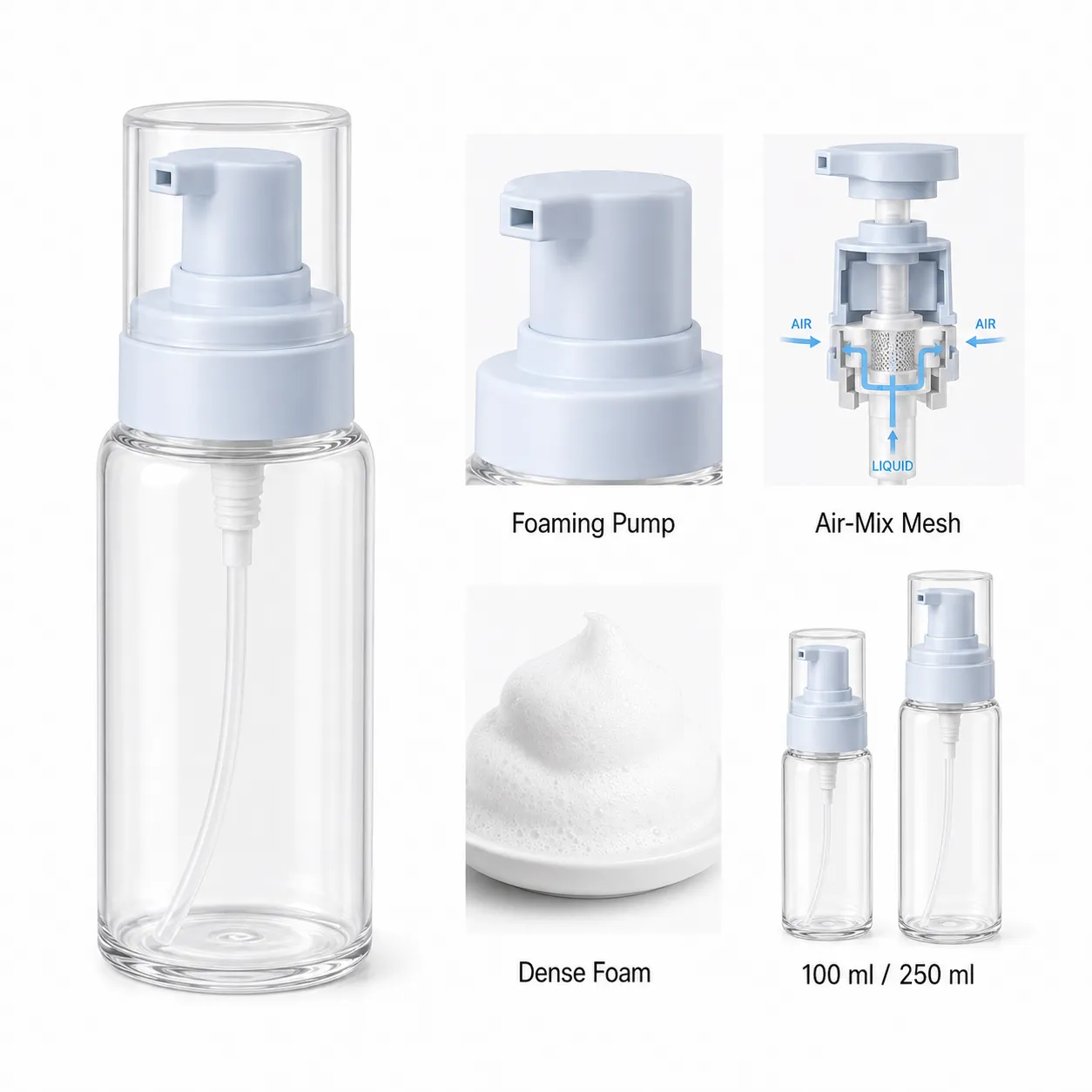
Define the cleanser brief before requesting samples
Give the supplier the formula identifier, intended fill amount, application and expected foam experience. The formulation team should identify properties relevant to dispensing, including flow behavior, particles and ingredients that may affect product-contact components. Share the intended storage conditions and ask the supplier to state the operating limits of each proposed pump model.
Do not replace that discussion with a universal viscosity cutoff. Different formulas can behave differently in the same pump. If a supplier recommends diluting a formula, refer the proposal to the formulation team; changing the cleanser is a product-development decision, not a packaging adjustment.
Compare the complete assembly, not only the mesh
A manual foamer brings liquid and air together before dispensing foam. The pump’s mixing elements are only part of the result. The bottle neck, closure seal, dip tube, actuator and formula also need to work together. Request a model drawing and component specification so the samples being compared can be identified later.
- Bottle and closure: confirm the neck drawing and assembled fit; a matching nominal diameter alone is insufficient.
- Dip tube: request the proposed length and cut, then check dispensing near the bottom of the filled bottle.
- Actuator: assess pressing comfort, nozzle direction and residue after repeated use.
- Lock or overcap: check that the chosen transport arrangement does not damage the actuator or interfere with reopening.
For available package directions, review Oulete’s spray and foamer bottle options. Fine-mist and foamer mechanisms are different formats; do not assume their pump heads are interchangeable.
Run a repeatable filled-sample comparison
Label each sample with its pump model, bottle model, formula batch and fill amount. Use the same filling and conditioning procedure across candidates. Agree sample quantities, conditions and acceptance criteria with the formulation and filling teams before starting. The following is a planning checklist, not a universal certification protocol.
- First use: record how many full strokes are needed before useful foam appears. Separate dry priming from normal dispensing.
- Steady output: collect several full strokes consistently. Record delivered mass and variation. State whether the result refers to liquid mass or expanded foam volume.
- Foam experience: compare bubble appearance, spread, drainage and the feel expected for the cleanser. Photograph samples using the same timing and lighting.
- Pause and restart: repeat after agreed storage intervals. Look for drying residue, delayed recovery or a change in foam quality.
- Near-empty use: inspect intermittent dispensing and remaining product. Do not assess evacuation using a full bottle only.
Check leakage and compatibility separately
Good-looking foam does not establish a reliable package seal. Check the filled, closed assembly in the intended upright and transport conditions, including the lock or cap arrangement. Record leakage location: the nozzle, closure and bottle can require different corrective actions.
Ask the responsible product-development team to define compatibility and stability work for the final commercial assembly. Inspect product-contact parts, seals and the formula after the agreed conditions. A resin name or supplier’s general material statement is not a substitute for evidence covering your formula and package.
Use observed faults to narrow the next trial
If the foam is watery, compare the formula and pump together instead of ordering a finer mesh automatically. If output falls after storage, inspect residue and recovery. If delivery becomes intermittent near the end, review dip-tube fit and bottle geometry. Change one documented variable at a time so a better result can be attributed to a specific change.
Keep an untouched reference sample from each version. Changing the pump supplier, seal, tube cut, bottle neck or formula should prompt a review of the affected checks.
Turn the approved sample into a purchase specification
Record the approved component identifiers, materials, color, fill target, decoration, assembly arrangement and test acceptance criteria. Include packing instructions and a retained reference. Request a quotation based on that specification rather than assuming the lowest-priced pump is equivalent.
Send the cleanser application and required sample assembly through Oulete’s packaging enquiry page. Confirm the scope of component manufacture and sourcing in the quotation. The brand and its formulation or filling partner remain responsible for product-specific validation.
Frequently Asked Questions
Can a regular lotion be used in a foamer bottle?
Do not assume it can. Request the pump’s operating limits and test the intended formula. Reformulation, if needed, must be assessed by the formulation team.
Does a mesh number guarantee finer foam?
No. Evaluate the complete dispensing system with the cleanser; a mesh specification alone does not establish the finished foam experience.
What should be retained after sample approval?
Keep the approved assembly, formula identifier, component specification and trial record. These make later production samples comparable to the approved version.