


A cosmetic packaging order can spend more time waiting between processes than moving through a machine. That waiting becomes a quality concern when unmarked containers, similar colors or held lots share a staging area. A practical work-in-progress review asks where parts wait, how their identity survives and who can release them.
Quick Answer
Control cosmetic packaging work-in-progress by marking each container of parts with job, component revision, lot and status. Define staging locations and queue ownership, segregate holds and rework, and reconcile quantities at each transfer. Improve flow using measured waiting and handling evidence. Do not remove required inspections simply to make a queue look smaller.
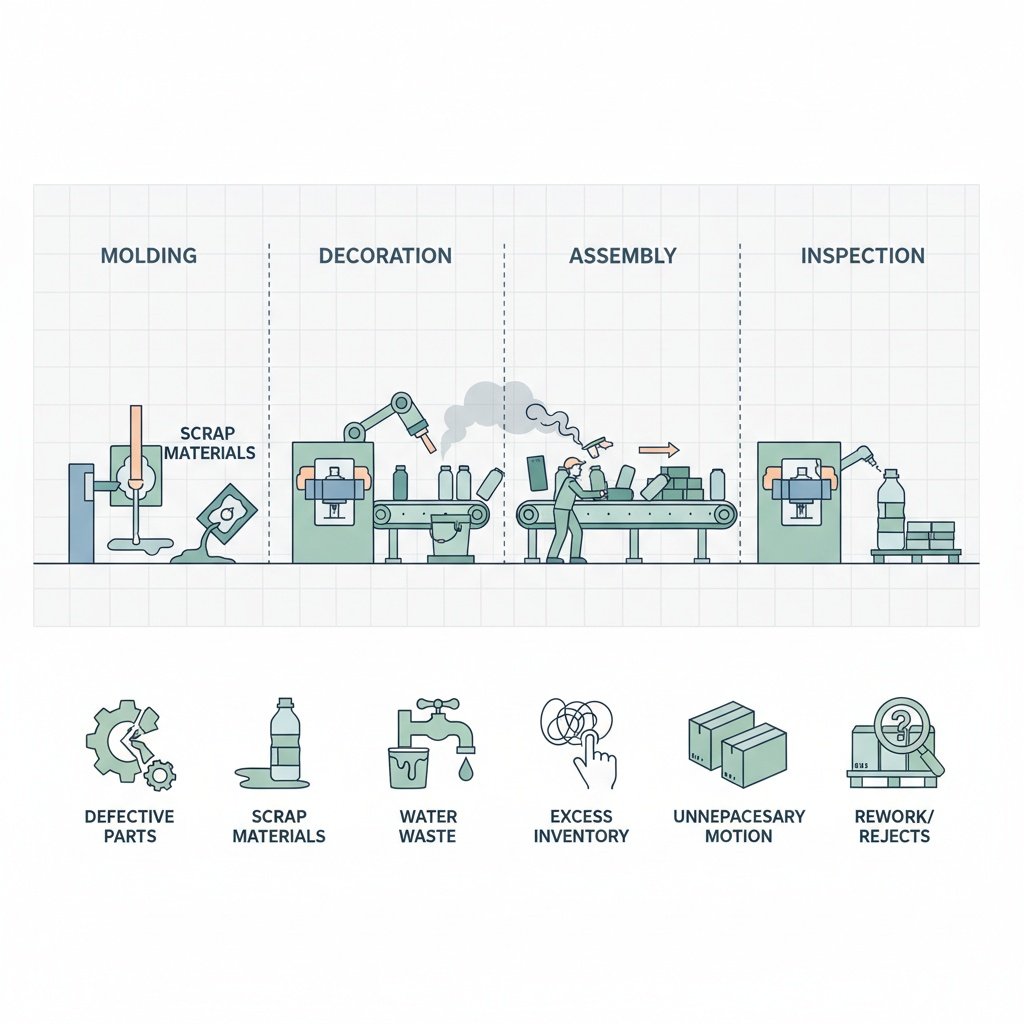
Map one real job from molding to packout
Select an actual order and follow its components through the agreed operations. Record each handoff, storage location, receiving quantity and time. Include outsourced decoration and purchased components. A factory layout diagram does not reveal which parts of the route apply to the selected SKU.
Distinguish processing time, waiting time and hold time. An intentional hold for inspection or conditioning has a different purpose from an unowned queue. Make the reason visible before deciding whether to shorten, eliminate or protect the step.
Keep identity attached to the physical parts
Every tray, tote or carton needs an identity that remains useful when a large lot is split. Include the component description, revision, lot, quantity and current status in the agreed record. If labels can be removed during washing or decoration, define how identity is transferred rather than assuming the next operator will recognize the part.
Do not merge similar-looking parts solely to save space. A change in resin, insert, artwork or closure may be invisible at a glance. Review which combinations can legitimately share a lot and which must remain separate, including the quantities issued for trials.
Make queue ownership explicit
For each staging area, name the receiving process and responsible owner. Agree how a job is prioritized and how long an unexplained delay can remain before escalation. Avoid a generic first-in-first-out rule where a required hold, cure or release condition takes precedence.
Review storage protection alongside queue size. Stacking, exposed surfaces or repeated handling can damage an accepted decoration. A shorter queue is not an improvement if the new arrangement creates scratches, contamination risk or mixed components.
Separate good, held and reworked material
- Use unambiguous physical locations and status labels.
- Define who can change a hold to released status.
- Retain the defect reason and affected quantity.
- Record rework input, recovered output and losses.
- Apply the agreed reinspection before returning parts to good stock.
Rework should not disappear into a favorable output figure. If a component requires repeated sorting, investigate the upstream cause while maintaining the required containment. Removing the check does not remove the defect.
Measure improvement without hiding losses
Compare equivalent jobs or document the differences in quantity, geometry and decoration. Track accepted output, waiting duration, number of transfers and damaged or missing parts. Record interruptions that affect the interpretation. Do not promise a universal percentage reduction from a new rack layout or a lean label.
Ask whether the improvement remains effective after a shift change and during mixed-SKU production. An arrangement that works only while a specialist supervises it may need clearer standard work. Keep operator feedback in the review because daily handling problems may not appear in a planning spreadsheet.
Tie flow control to the approved order
Retain the process map, handoff record and status rules with the order’s specification. The sample approval checklist identifies the component revisions that flow controls must preserve. Ask Oulete about the selected project’s process route and where purchased or outsourced parts enter it.
Use a transfer record that follows split lots
A useful handoff record travels with the physical container and remains readable at the next process. When a lot is split, give each child container a traceable identity and retain its connection to the parent lot. Copying the same label onto several totes without quantities can make later reconciliation ambiguous.
| Transfer field | Purpose | Receiving check |
|---|---|---|
| Job and component revision | Identify the intended assembly | Match the next operation’s specification |
| Parent and split-lot identity | Preserve origin after separation | Confirm every container is accounted for |
| Quantity and status | Separate available stock from holds | Record discrepancies before use |
| Sender and receiver | Assign the handoff | Confirm location and responsibility |
Where the next operation changes the label or container, define how the replacement identity is verified. Keep the original and replacement references linked. The receiving team should not have to infer a lot from colour, tray position or a handwritten nickname.
Investigate a mixed-queue discrepancy
For example, two similar cap colours may arrive at decoration in separate totes, but one tote carries a quantity inconsistent with the sending record. This illustrative discrepancy should trigger reconciliation before the parts enter a shared feeder. Inspect the labels, transfer counts and previous staging locations without assuming that the mismatch is merely a counting error.
If the identity cannot be confirmed, use the agreed hold procedure. Sorting by visual similarity alone does not restore a missing revision or material history. Record the resolution and the affected quantities so the next process receives a clear status.
Improve one handoff before changing the whole route
Select a recurring queue and observe how jobs enter, wait and leave it. Record the reason for waiting and the extra handling involved. A marked staging location or clearer receiving ownership may address the problem without moving every operation or removing an inspection.
Compare the revised handoff under equivalent conditions, including a shift change where relevant. Retain both the flow improvement and any new damage or identity issues. The decision should explain what improved and what still constrains the order, not just report a smaller number of visible totes.
FAQ
Is all waiting waste?
No. Some holds protect quality; identify the reason and release condition first.
Can similar colors share one staging tote?
Only under an approved identity and segregation method, not by visual similarity alone.
Does lower WIP guarantee shorter delivery?
No. Measure the actual route, constraints and accepted output.