


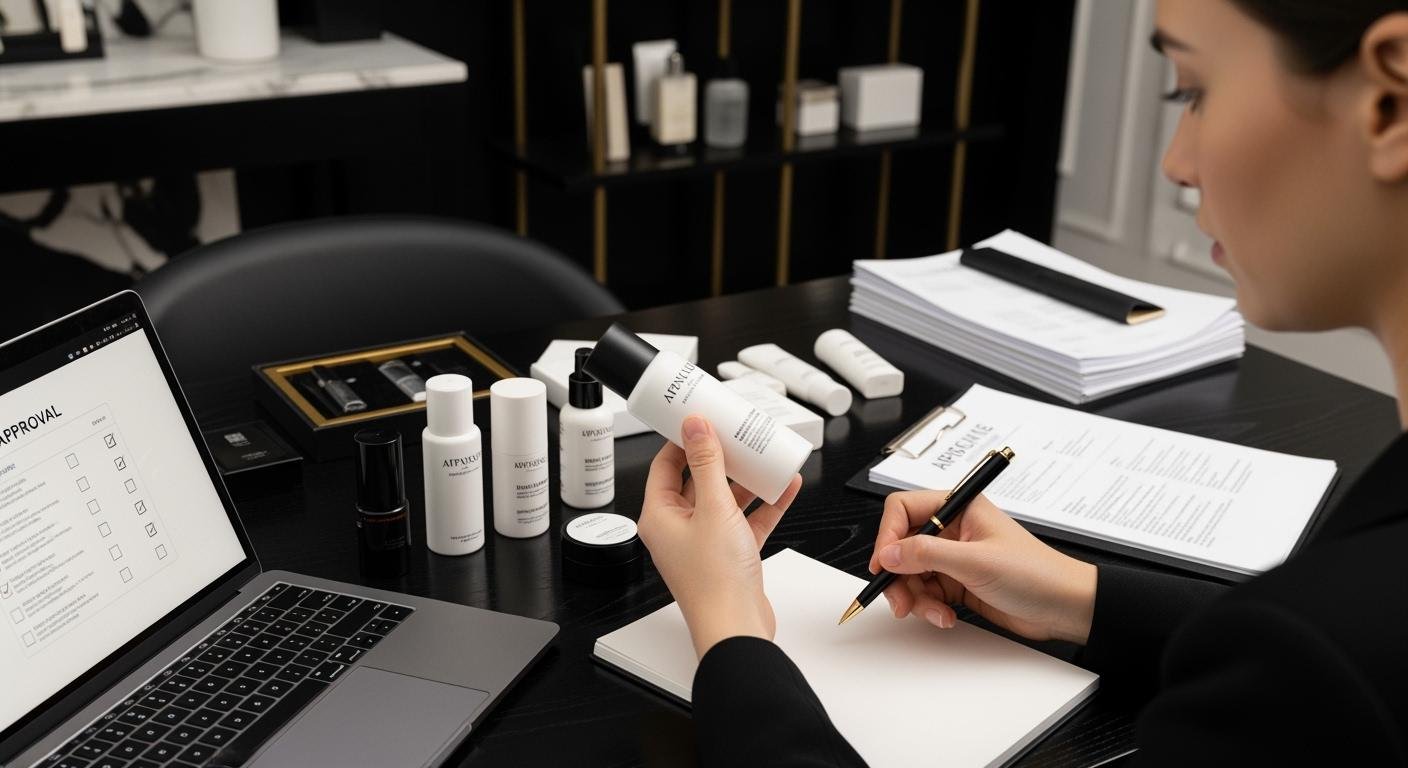
The cosmetic packaging sample approval process should connect your product brief to a documented production specification. A bottle can look correct while its closure leaks, its pump delivers an unsuitable dose or its decoration fails after product contact. Approval should cover appearance, dimensions, functionality and formula compatibility before bulk production is released.
Quick Answer
Before approving cosmetic packaging for mass production, check the complete container and closure against your actual formula and filling process. Review dimensions, leakage, dispensing, material compatibility, decoration quality and transport performance. Approve production-representative samples, retain a signed master sample, and document the drawing revision and acceptance criteria. Appearance approval alone is not enough to confirm that a filled package will perform reliably.
Identify Which Sample You Are Reviewing
A stock reference sample, a handmade appearance mockup and a production-representative sample answer different questions. Record how each sample was made, its material and component revisions, and whether it represents the proposed production process. Do not treat a visual mockup as evidence of functional performance.
Use Oulete’s custom packaging services to agree the sample stages and approval responsibilities. For each stage, state what can be approved and which checks remain open.
Check Dimensions and Filling Fit
Compare the sample with the approved drawing. Review overall height, diameter, neck finish, closure engagement, usable fill volume and the dimensions that affect filling or labeling equipment. For tubes, confirm diameter, length, filling access and the planned tail-sealing process.
Set tolerances for the actual component and manufacturing process. A general carton tolerance is not an appropriate substitute for a bottle neck or pump connection specification. Your filling partner should review the package before production release.
Approve Appearance and Decoration
- Compare color with a physical master under agreed lighting.
- Check logo placement, registration, text legibility and artwork revision.
- Inspect the surface for scratches, uneven coating and print defects.
- Test decoration adhesion and resistance to handling or formula contact.
- Confirm that required product information is reviewed by the responsible brand team.
A digital proof helps check wording and layout, but it does not establish the final color or finish on a curved bottle. Retain a decorated physical sample and agree how acceptable variation will be measured.
Test the Closure and Dispensing System
| Package type | Functional checks |
|---|---|
| Pump bottle | Priming, dose consistency, actuator return and leakage |
| Dropper bottle | Closure fit, pipette length, dose behavior and bulb compatibility |
| Cream jar | Lid fit, liner contact, seal performance and repeated opening |
| Tube | Cap fit, dispensing opening, tail seal and deformation |
| Airless package | Filling method, piston or bag operation, dispensing and residual product |
For skincare airless bottles, test the complete assembly with the intended formula. For dropper bottles, include the bulb, collar, gasket and pipette rather than checking the glass body alone.
Agree leak-test conditions relevant to storage and transport. An inversion check can reveal some problems, but it does not replace a defined test plan. Use pressure, temperature or transport simulations where appropriate to the package and distribution route.
Assess Formula Compatibility
Fill samples with the actual formula and review changes in the product and every product-contact component. Watch for discoloration, odor changes, haze, swelling, cracking, corrosion and loss of seal performance. Also record dispensing changes after storage.
The development team should define the test duration, conditions and acceptance criteria. A short sample inspection cannot establish full shelf life. When the formula, resin, gasket or other component changes, review whether the earlier approval remains valid.
Review Packing and Distribution Protection
Check how the containers are protected in cartons and how the filled products will be shipped. Inserts should hold the selected package without damaging decoration or stressing the closure. Review drop, compression or other handling tests suited to your distribution process.
Include transport locks, cap protection and separation between fragile components where needed. An attractive individual package still needs an appropriate shipping configuration.
Create a Written Approval Record
| Record | Purpose |
|---|---|
| Drawing and component revision | Defines the approved structure and materials |
| Artwork and color reference | Controls visual identity and printed information |
| Test results | Records functional and compatibility findings |
| Signed master sample | Provides a physical comparison reference |
| Inspection criteria | Defines defects, tolerances and acceptance decisions |
| Approval owner and date | Shows who authorized production and on which basis |
Classify the decision as approved, approved with clearly stated conditions, or rejected. Document unresolved issues and any required resampling. Do not use vague feedback such as “looks fine” as the sole production release.
Use Change Control After Approval
Supplier changes to resin, tooling, closure parts or decoration can affect performance. Require proposed changes to be disclosed and reviewed. A retained master sample should be paired with written specifications; it cannot replace material traceability or measured acceptance criteria.
To organize samples and a production brief, contact Oulete for a quote and sample review. Provide the formula type, capacity, dispensing requirements, artwork and planned quantities.
FAQ
What is a golden sample?
It is an approved physical reference used with the drawing, material specification and inspection criteria. It helps compare production but does not guarantee every unit is identical.
Can I approve packaging using an empty sample?
You can review appearance and some dimensions, but filled-sample testing is needed to evaluate compatibility, leakage and dispensing.
How long should compatibility testing take?
The duration depends on the formula, package and development plan. Your technical team should define conditions and criteria rather than relying on a universal short test period.
What happens if a sample fails?
Record the issue, agree corrective action, retest where necessary and obtain a new documented approval before releasing the affected production.