


Quick Answer
Evaluate partial lotion-pump presses as a user-action question, not as guaranteed fractions of the nominal full-stroke dose. Record the gesture, actuator return, collected product and the next press on the identified filled assembly. Keep these observations separate from controlled full-stroke measurements. A shorter press does not, without evidence, mean a proportional or repeatable smaller amount.
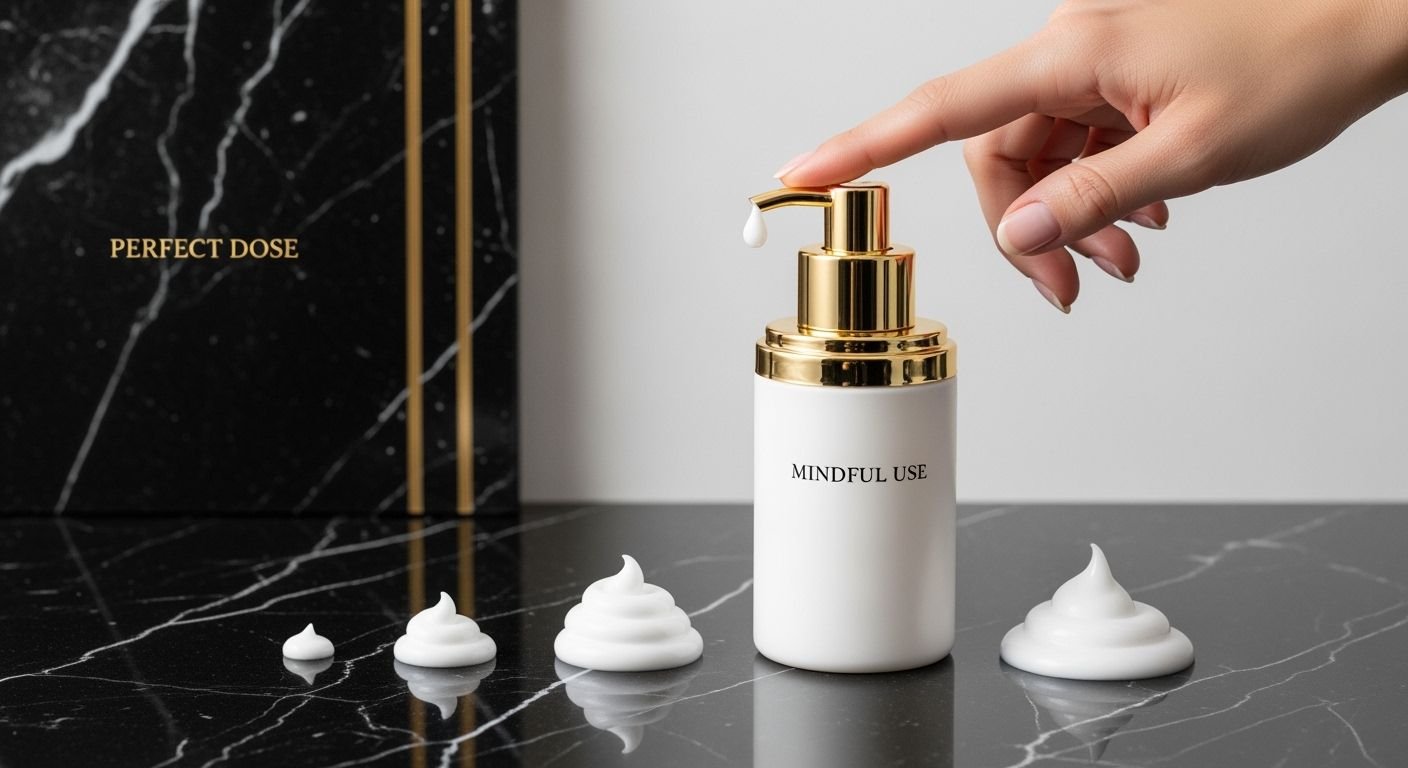
A product team may prefer a small application amount while the selected pump has a larger nominal option. It can be tempting to tell users to press halfway. Before making that instruction, the brand needs evidence for the actual gesture and assembly. This article separates that user trial from choosing a catalog dose or assuming a universal relationship between travel and output.
Establish a controlled full-stroke reference
Ask the testing team to define a full actuation and release for the selected pump. Record the pump, actuator, bottle, dip tube where present, formula and fill state. Distinguish priming from established operation. The reference gives later observations a clear comparison basis; it does not automatically approve the gesture a consumer actually uses.
Keep output units and measurement method explicit. Report collected mass as mass unless a justified volume measurement or conversion is available. The pump selection discussion frames the wider choice, while this trial examines incomplete actuation and return. Do not borrow a nominal dose or tolerance from another dispenser.
Describe the partial gesture reproducibly
Agree how the trial represents a shorter press, early release or interrupted movement. The responsible team should choose a method appropriate to its question. Record whether the action is controlled mechanically or observed from users. Those methods can answer different questions and should not be reported as identical data.
A user’s description of half a press is ambiguous unless the actual action is observed. The actuator may move an uncertain distance, pause or be released before completing its return. Capture the relevant movement and sample reference where useful. Do not invent a travel dimension simply to turn a subjective gesture into a precise-looking result.
Observe release and the next actuation
After the partial press, record whether the actuator returns as expected and what occurs at the outlet. The next press belongs in the same sequence because it follows a different history from an isolated full stroke. Note delayed product delivery, interruption or residue without assigning a cause from appearance alone.
Compare like sequences across candidate assemblies. If the full-stroke reference, partial gesture and next press use different formulas or fill states, preserve that difference instead of attributing the outcome solely to stroke length. Identify pauses and any handling between actions so another reviewer can interpret the result.
| Sequence | Question | Record boundary |
|---|---|---|
| Controlled full stroke | What is delivered under the agreed method? | Reference result and units |
| Shorter press | What gesture was actually performed? | Movement and collected output |
| Release | Does the actuator recover? | Return observation and pause |
| Following press | Does the previous action affect the sequence? | Same sample and history |
| User trial | Can the intended action be understood? | Observed gesture, not an assumed fraction |
Do not average away different actions
Keep full strokes and partial actions in separately identified groups. An overall average from mixed gestures cannot establish controlled output consistency. Retain the order of observations and distinguish units from repeated actions on one unit. A total collected amount divided by the number of gestures is not raw individual-gesture data.
Record unsuccessful collection, spills and delivery failures distinctly. Do not delete a result merely because it is inconvenient. The protocol should define how such events are handled and which observations remain relevant. A clean spreadsheet is not a substitute for preserving what occurred.
Compare gesture difficulty with the intended application
Have representative reviewers describe specific difficulties, such as reaching the actuator, stopping the movement where intended or waiting for its return. Identify the filled bottle they used. A general preference for the pump’s appearance is useful design feedback but does not demonstrate repeatable partial dosing.
The brand should decide whether the intended instructions are understandable and whether the candidate meets its application needs. If a smaller nominal pump option is available, evaluate it as a separate proposal instead of claiming that shorter movement converts the original into that option. The supplier must identify the proposed dispenser reference.
Use alternative parts as controlled candidates
A different actuator, engine or outlet can create a new assembly even when the bottle stays the same. Give each candidate its own component list and trial sequence. Review the interfaces affected by the change, then compare findings on a common basis. Avoid changing the formula and several parts simultaneously if the question is about actuation.
For example, a hypothetical user group might perform shorter presses inconsistently while a controlled full-stroke test remains stable. That finding describes different trial scopes; it does not prove the pump is defective or the users are wrong. Preserve the observation and revisit the intended application and candidate options. This is an illustrative scenario, not an Oulete study.
Keep the purchasing description honest
Request an identified lotion bottle and pump proposal with its available nominal options, then attach the findings to the sample approval record. A wholesaler should not convert informal partial-press feedback into a guaranteed dosage claim on a product listing.
Separate functional findings from static sealing, formula compatibility and life-cycle checks. A satisfactory gesture does not establish shelf life or transport security. Keep the actual formula and assembly identities shared across those records without merging their different conclusions.
Prepare a dispensing brief
Send the intended application amount, user action, formula category and existing candidate through the packaging enquiry page. Ask whether an appropriate lower-output option can be proposed and what sample review is needed. Oulete’s MOQ is 5,000 pieces for plastic lotion bottles and plastic airless bottles, and 10,000 for glass packaging and cosmetic tubes. Confirm the actual offered configuration and customisation separately.
Frequently Asked Questions
Does half a stroke deliver half the listed output?
Do not assume that relationship. Evaluate the actual assembly and gesture.
Can mixed presses demonstrate full-stroke consistency?
No. Keep the controlled reference and additional user actions separately identified.
Should instructions be approved before observing users?
Use the trial to evaluate the proposed instruction and action; the brand retains responsibility for the final product guidance.