


Quick Answer
Choose travel size skincare bottles by the usable formula delivered, not just the nominal capacity. Check the intended fill, pump priming, dose, residual product, closure security and label space. Test the filled bottle inside its actual travel kit; a small container or locking pump alone does not establish leak resistance.
A miniature should make a short skincare routine practical. It also needs to be filled, labeled and handled without creating problems that were absent in the full-size pack. The most useful development brief connects the mini bottle to the number of uses promised and to the way it will be packed.
Separate Nominal Capacity from Usable Fill
Ask for the recommended working fill and the filling method for the selected assembly. Do not treat overflow capacity as the commercial fill. Leave the clearance required by the closure and filling process, and confirm that the filler can reach the proposed quantity consistently.
Measure what the consumer can actually dispense. For a pump mini, record the amount used during priming, the output after priming and the product remaining when dispensing becomes unacceptable. Formula behavior and the selected mechanism affect these observations; scaling down the large bottle does not prove that the miniature works the same way.
Translate the Routine into a Test Brief
Define the intended application amount with the product team. Weigh repeated dispenses from representative filled samples rather than assuming a fixed amount from the pump name. Use the measured output and usable fill to estimate the number of applications, with an allowance for the observed variation.
| Question | Check on the filled mini |
|---|---|
| Does it start reliably? | Record priming attempts and product consumed before a usable dose. |
| Can the user control the dose? | Observe full and partial actuation, squeeze control or pipette handling as appropriate. |
| Does it empty acceptably? | Record residual product and the point at which dispensing becomes inconsistent. |
| Can it be closed after use? | Check the cap or lock with product residue present and after repeated use. |
Test the Bottle Inside the Kit
A secure closure on the bench can behave differently when another item presses against it. Fill the intended bottles, close them using the agreed procedure and place them in the actual pouch, tray or carton. Review contact between neighboring packs and whether movement can unlock or actuate a pump.
- Check intended storage orientations and handling conditions defined for the project.
- Distinguish product leakage from accidental dispensing into the cap.
- Inspect cap retention, closure threads and decoration after the agreed handling test.
- Check whether a user can identify and reclose each pack without mixing up similar caps.
Use an agreed transport and compatibility test plan with the responsible teams. Avoid describing the pack as universally leakproof or approved for every journey. Airline and destination requirements should be checked separately for the actual trip.
Reserve Space for Identification
Review the decorated sample at the final size, not only an enlarged artwork file. Confirm that essential product identification, batch coding and the label layout can be applied clearly. Check curved areas, seams and the gripping surface so printing does not disappear under a cap or rub during routine handling.
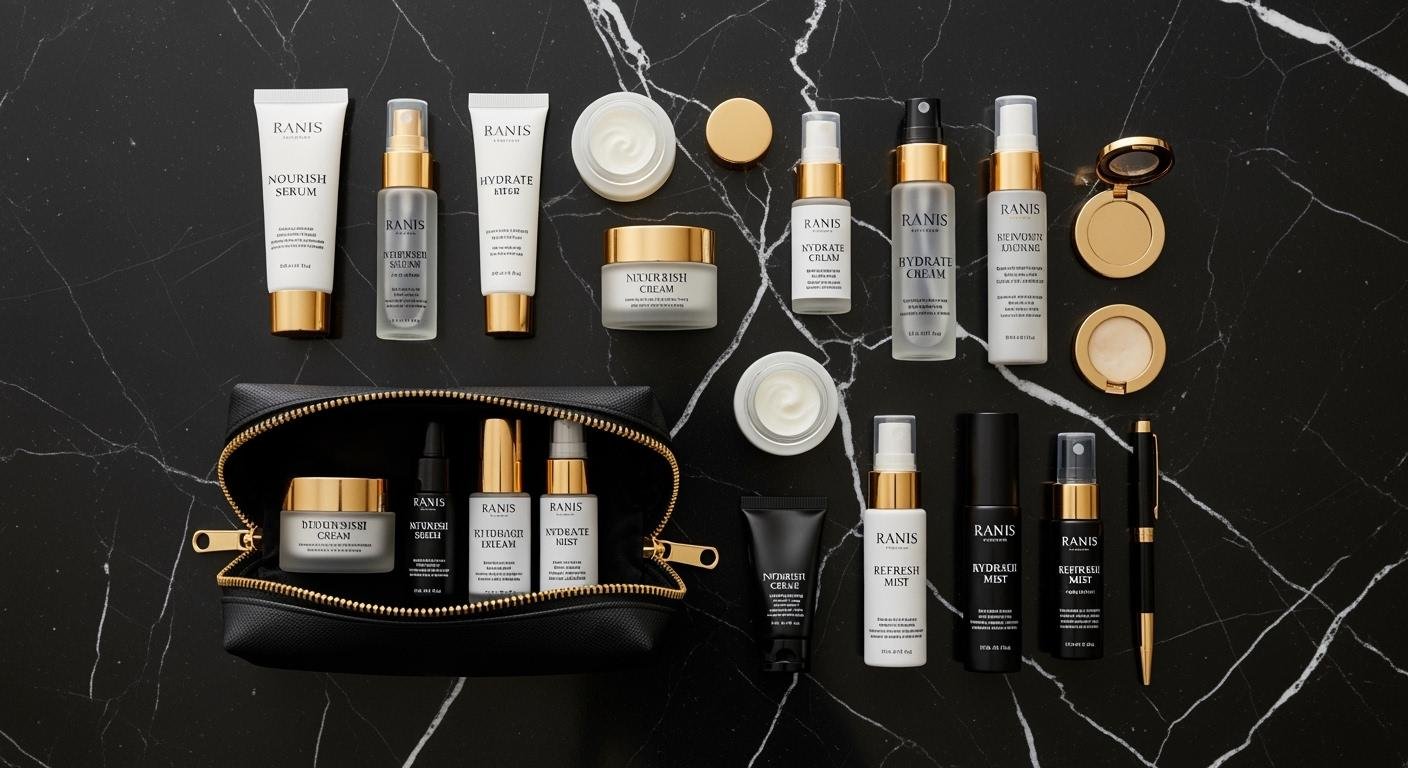
For a multi-product kit, use a consistent visual hierarchy while keeping cleanser, serum and moisturizer distinguishable. Similar bottle shapes can simplify the kit, but they should not force different formulas into one dispensing system without testing.
Approve the Mini as Its Own Package
Compare suitable airless bottle options, then use our sample approval checklist to capture the mini’s fill, closure and decoration revisions. Send the proposed kit and formula types when requesting samples.
Common Questions
Can a full-size bottle simply be reduced?
Not without review. Filling access, priming consumption, gripping space and label area may become more important at a smaller size.
Is a locking pump enough for a travel kit?
No. Check the actual locked assembly inside the packed kit, including contact with adjacent items and accidental unlocking.
Should every mini in a kit use the same closure?
Only when dispensing and compatibility checks support it. A consistent appearance should not override each formula’s requirements.