


Quick Answer
Give every serum comparison candidate a defined formula, bottle, applicator and fill condition. Decide which variable the kit is intended to compare. If several variables change together, record that limitation rather than attributing the result to bottle capacity alone.
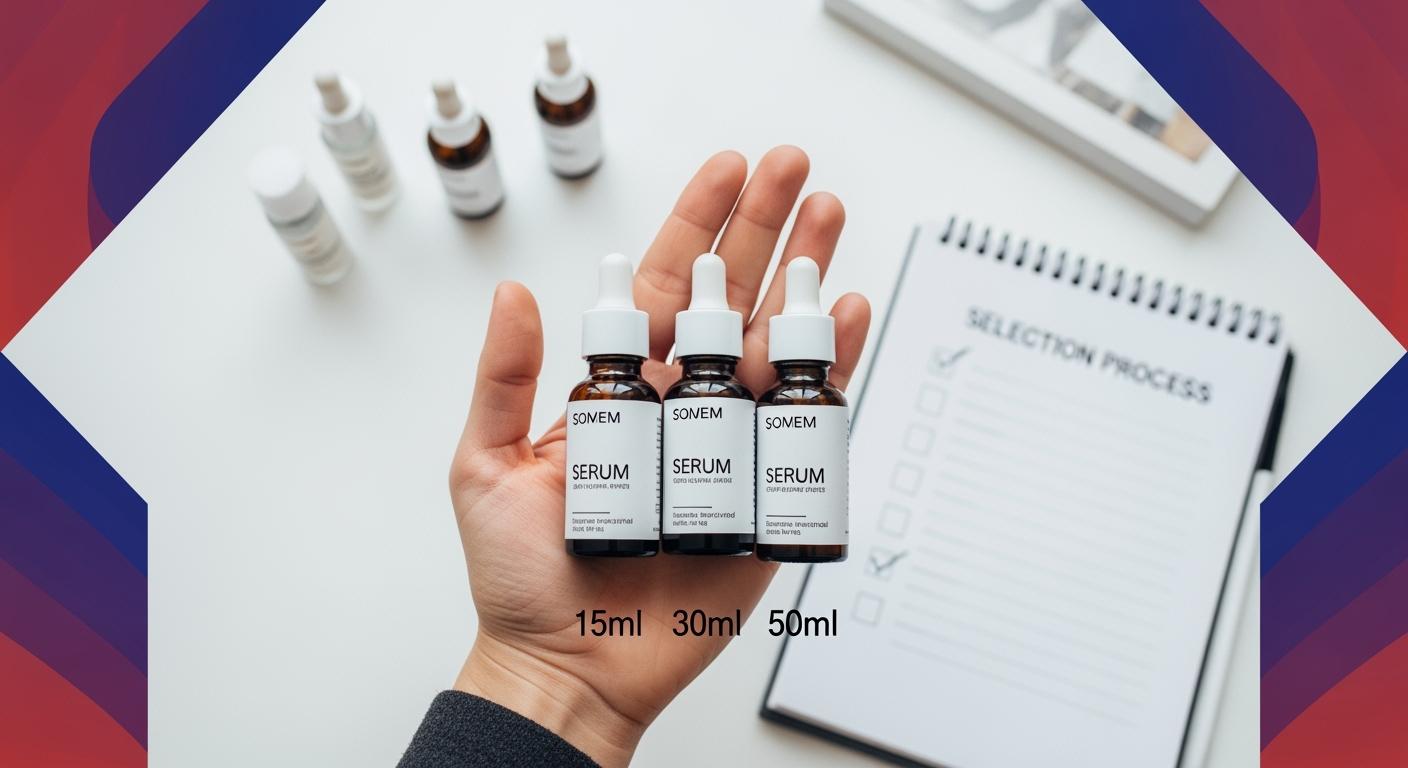
A beauty brand may receive a small dropper bottle, a larger pump bottle and an airless pack, then ask which size performs best. That kit changes both capacity and dispensing construction. It can help shortlist complete formats, but it cannot isolate a size effect. The comparison needs a clear question before samples are distributed to designers, fillers or customer teams.
Choose the comparison question first
Write one primary decision for the kit: select a dispensing format, compare two capacities within a family, or review the assembled appearance. If several decisions are necessary, create separate sections or rounds rather than asking one undefined preference question.
Keep technical assessment separate from commercial preference. A buyer may prefer the appearance of a dropper while the filler needs to review its closure operation. Those results can both inform the project, but they should not be compressed into a statement that one candidate is best in every respect.
List the variables for each candidate
Record the bottle reference and revision, closure or dispenser, formula identity, fill condition and decoration. Include any development substitute. A row labelled 30 ml alone does not describe the construction that produced the observation.
Mark what stays constant and what changes. If the same formula is assessed in two different capacities but the pump also differs, say so. Do not hide an unavoidable difference; it helps the responsible reviewers understand which conclusions the comparison can support.
| Candidate field | Keep identified | Comparison question |
|---|---|---|
| Formula | Same version or stated difference | Is packaging or product changing? |
| Dispenser | Exact pump or dropper assembly | Is delivery construction constant? |
| Capacity and fill | Container reference and actual fill condition | What size-related condition is represented? |
| Appearance | Colour and decoration state | Could presentation influence preference? |
Do not use capacity as a performance claim
A smaller bottle does not automatically preserve a formula better, and a larger one does not automatically waste product. Have the formulation and packaging teams define the relevant study for the intended product and use. Keep a short comparison trial within its scope instead of turning it into a shelf-life conclusion.
Likewise, a nominal volume does not define delivered dose. A dropper, pump and airless actuator require their own operation and delivery review. Do not compare a number of drops directly with a number of pump strokes as though they were identical quantities.
Use consistent preparation where the question requires it
Have the responsible team specify preparation, starting state and operation for the comparison. Record any necessary priming or setup by candidate. A pack tested immediately after filling and another tested after different preparation may produce observations that are not directly comparable.
Keep candidate identity visible in the technical record. If a preference exercise uses neutral labels, maintain the mapping separately with the project owner. Neutral labels do not remove physical differences or turn a small informal exercise into a representative consumer study.
Separate the observation categories
Record dispensing behaviour, closure handling, filler interface and visual preference in separate fields. A favourite colour cannot offset an unresolved closure issue. An acceptable mechanical observation does not prove compatibility or product safety.
Ask reviewers to describe what they saw before interpreting why. For example, note difficulty reaching the remaining product instead of concluding that all large bottles perform poorly. The responsible team can then decide whether the bottle geometry, dispenser or operation requires further investigation.
Plan the next comparison after a mixed result
If the larger pump candidate dispenses differently from the smaller dropper, decide which question needs isolating next. The next round might retain one dispensing assembly across identified capacities, where feasible, or compare applicators within the same bottle family.
Do not force a controlled comparison where the parts are incompatible. Ask the supplier what complete combinations are available, and label any remaining differences. A transparent comparison of real assemblies is more useful than a fictional matched kit built around assumed interchangeability.
Keep the selected configuration complete
Once a candidate is shortlisted, retain its bottle, dispenser, formula and relevant preparation references together. The supplier’s later quotation should identify the same configuration or clearly state a proposed change. A general instruction to quote the winning 30 ml bottle leaves the key assembly unresolved.
Record open work separately from the selection. The kit may support a direction for further development while compatibility, decoration or filler trials remain pending. Do not describe a shortlist decision as full production approval.
Request a purposeful sample kit
Oulete’s glass packaging starts at 10,000 pieces; plastic airless and plastic lotion bottles start at 5,000 pieces. Sample availability, selected serum formats and variant quantities require specific confirmation. Small capacity is not a guarantee of a low production MOQ.
Compare dropper bottle formats with other packaging options, retain the decision in the approval record, and send your comparison question through the enquiry page.
Frequently Asked Questions
Does a pump-versus-dropper kit compare only capacity?
No. It changes dispensing construction as well, and the conclusions must reflect that.
Can we order from the preferred candidate’s volume alone?
No. Carry the complete bottle and applicator references into the quotation and release review.