



Quick Answer
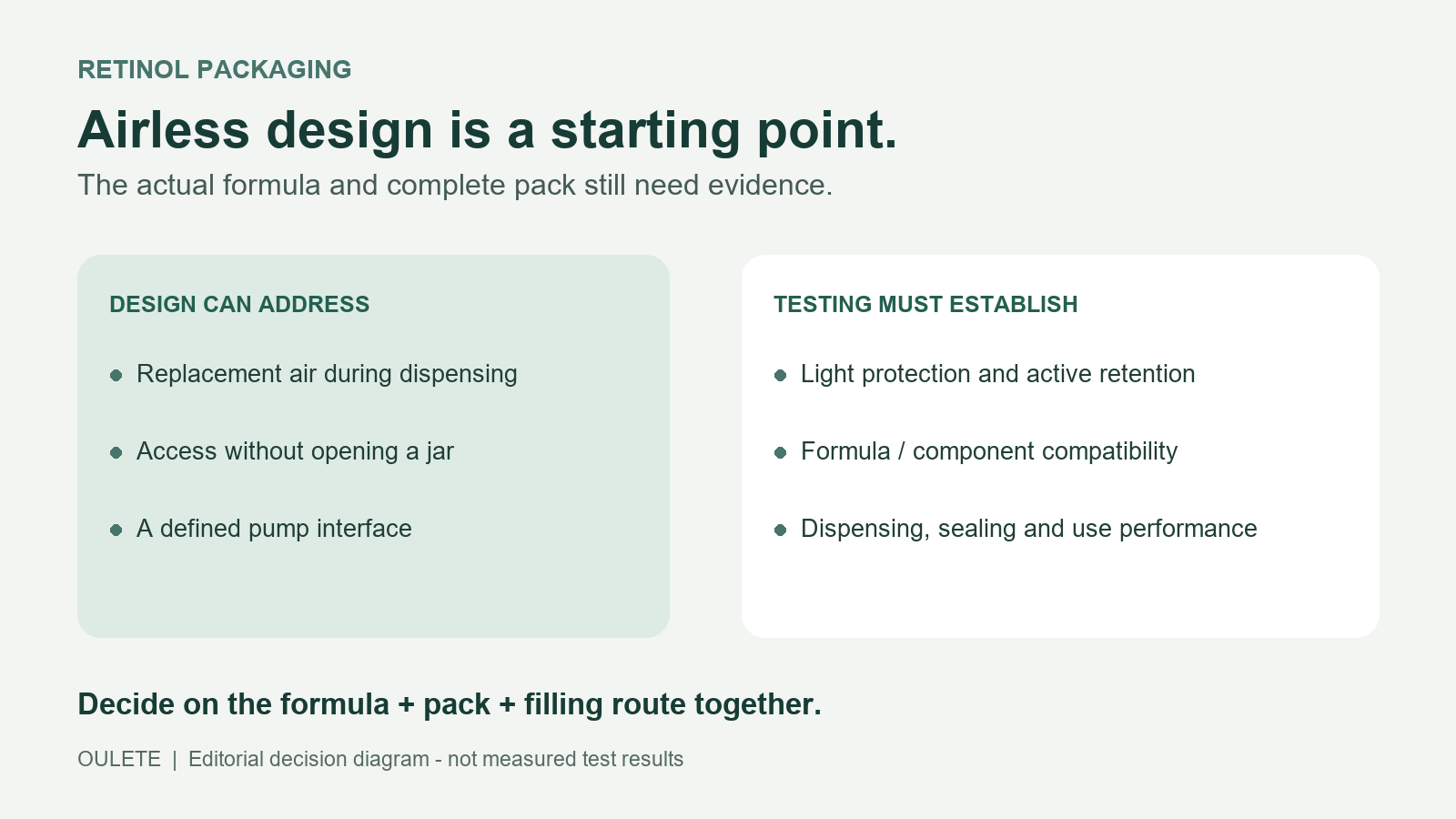
An airless package can limit the replacement air introduced into the product chamber during dispensing and let users take a dose without opening a jar. It does not, by itself, prove light protection, zero oxygen exposure, retinol retention, microbiological suitability or shelf life. Select the actual formula, complete pack and filling route together, then ask the formulation and testing teams to establish the evidence needed for release.
For cosmetics companies, contract fillers and wholesalers, the useful buying question is: which exposure does this design address, and which result is still unverified? This guide turns that question into a packaging brief. It is a source-based purchasing guide, not an Oulete laboratory study, medical recommendation or validated test protocol. Sources checked on 28 October 2026.
Start with the retinoid and the actual formula
A proposal described only as a retinol bottle leaves essential information open. Ask the formulation owner to identify the ingredient, formula revision and product form. Retinol, retinal and retinyl esters should not be treated as interchangeable names, and an acceptance result for one finished product should not be transferred to another simply because both are marketed as vitamin A skincare.
A published study of retinoids in commercial cosmetics found that stability depended on formulation and that light exposure was important in the products studied. Its findings support product-specific evaluation; they do not identify a universally best bottle or establish the shelf life of your formula.
Give the supplier the information needed to propose an assembly: intended fill, product texture, dispensing requirement, target markets and use pattern. Arrange sensitive formula details through an agreed confidential exchange. The packaging quotation need not disclose the complete recipe publicly, but the people evaluating compatibility need an adequately identified test formulation.
What an airless structure can address
Replacement air during dispensing
In a typical piston system, a moving piston reduces the product-chamber volume as contents leave; in a bag system, the inner chamber collapses. The purpose is to avoid replacing every dispensed portion with outside air in that chamber. The pump, valves and chamber remain an assembly to evaluate, rather than a promise derived from the word airless.
The airless mechanism guide explains these structures. Manufacturer portfolios also show that different airless designs use different chambers and protection features; Aptar’s airless overview is one example, not a performance specification for Oulete products.
Access to the bulk product
A pump provides a dispensing route without removing a jar lid and reaching into the bulk each time. That can be a useful design choice for the intended use. It does not establish a sterile package or authorise removal of the formula’s preservation system. The actual outlet, cap, handling and in-use conditions still belong in the assessment.
A defined dispensing interface
The selected actuator and pump provide a specific action to assess with the formula. Buyers can request evidence for priming, repeated output, restart and residual product. Treat those as measurable questions for the proposed assembly. Do not convert a nominal pump output into a guaranteed delivered dose without an applicable check.
What the airless label does not settle
Light protection
A transparent airless bottle can still leave a light-exposure question unresolved. Identify the product-contact chamber, any outer shell, decoration, clear window, cap and carton in the study. A dark appearance or frosted finish is not itself a transmission report or a result for the filled product. For a windowed design, use the viewing-window evidence guide rather than assuming the mechanism also controls light.
Oxygen already present and protection over time
Limiting replacement air during use does not demonstrate the amount of oxygen present after filling, dissolved in the bulk, or entering through the complete package over time. Ask the technical team which of those questions matters and what evidence addresses it. Do not prescribe nitrogen flushing, a headspace limit or an oxygen-barrier figure without the actual process and relevant data.
Compatibility of every contacting part
An acrylic outer shell or glass body does not describe every surface the formula encounters. Identify the inner chamber, piston or bag, pump pathway, valves and seals. Ask the supplier to distinguish confirmed material references from parts still under review. A resin datasheet can support identification; it is not the result of storing your formula in the finished assembly.
Chemical, physical and microbiological stability
A pump that works and a cream that looks unchanged do not establish retinol retention. Chemical analysis, physical observations and the product’s microbiological assessment answer different questions. The formulation owner and qualified assessors must select the relevant methods and interpret the results. This article does not set an active concentration, preservation recipe or consumer treatment instruction.
Build an evidence request before comparing samples
The Cosmetics Europe/CTFA stability guidelines (2004) include product-container interactions and recommend assessing packaging representative of the marketed pack. This is industry guidance, not a certificate or a universal pass criterion. The following brief is an editorial planning aid for agreeing your own study.
- Define the comparison. Are you choosing between two complete packs, qualifying one final pack, or investigating a change? A comparison in which material, colour, pump and filling process all change cannot isolate the effect of the airless mechanism.
- Identify samples. Record formula and batch, pack and component revisions, decoration, intended fill and actual assembly state. Separate development samples from production-representative units.
- Agree measurements. Ask the laboratory about a suitable retinoid assay and relevant product observations. Ask the packaging team about sealing, priming, output, restart and residual product. Select controls, sample quantities and acceptance criteria before interpreting results.
- Define exposure and use. Have the responsible team justify storage, light, orientation, distribution and repeated-use conditions relevant to the project. Record whether samples stay unopened or are dispensed at defined intervals.
- Connect evidence to release. Keep the baseline, subsequent findings, deviations and decision owner. State what remains open instead of converting an incomplete trial into an approval.
The public scope of ISO/TR 18811:2018 likewise leaves the stability protocol to be specified and justified for the product. Do not turn a convenient accelerated storage period into a universal shelf-life conversion. Agree how real-time evidence will support the decision.
Use results to choose the next action
Hypothetical example, not an Oulete test: a retinol emulsion dispenses normally from an opaque airless candidate, but the agreed chemical check does not meet the product’s acceptance criteria. The successful pumping observation has not been invalidated; it simply answered a different question from active retention. Preserve both findings.
The next review should consider the identified formula, filling history, complete pack and exposure conditions. Do not immediately blame the resin or promise that switching to glass fixes the issue. If a second candidate changes several features, document those changes and interpret it as a comparison of configurations.
Conversely, an acceptable chemical result does not excuse a pump that stalls after storage or leaks during the relevant handling assessment. Release requires the evidence selected for the whole intended product, not whichever result is easiest to pass.
Give each buying team a usable handoff
- Brand/formulation owner: retain the formula reference, intended product claims, study scope and authorised release decision.
- Contract filler: retain the approved supplied state, filling and assembly instructions, sample preparation history and relevant line findings.
- Wholesaler: retain the exact sellable assembly and its evidence limitations. Do not list every variant as retinol-compatible based on one supplier sample.
Connect the records to the packaging sample approval file. A change in a contacting part, formula, decoration or filling route should trigger a review of which earlier results still apply; it need not be treated as either automatic acceptance or automatic rejection of every previous finding.
Prepare the enquiry without a stability promise
Review Oulete’s airless bottle options as candidates, then send the intended assembly and evidence requirements. Plastic airless bottles and plastic lotion bottles have a baseline MOQ of 5,000 pieces; glass packaging and cosmetic tubes start at 10,000. Confirm the chosen model, decoration, quantities per variant and sample scope in the quotation. A production minimum does not promise a particular testing-sample quantity.
Oulete’s company introduction provides supplier context. This article does not claim Oulete has tested your retinol formulation or that any catalogue model is already approved for it. The final decision belongs to the evidence for the actual formula and complete commercial pack.