


Quick Answer
Can you refill airless pump bottles? Only when the specific package is designed and validated for refilling. A sealed airless bottle is not automatically reusable. For skincare brands, a compatible replacement cartridge or pouch is different from opening an ordinary bottle and pouring new formula into it. Confirm the refill mechanism, formula compatibility, hygiene requirements and supported reuse cycles with the packaging supplier before launch.
Airless dispensing and refillability solve different problems. Airless describes how product is delivered; refillable describes how the pack receives another supply of product. Treating these terms as interchangeable can lead to damaged pumps, unreliable dispensing and unclear consumer instructions.
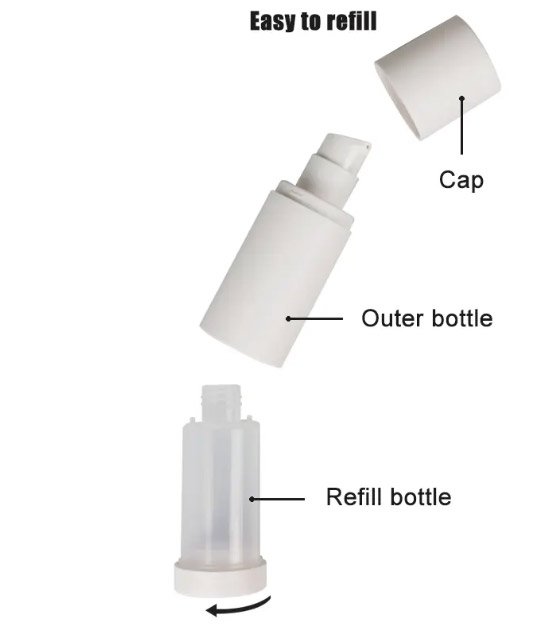
Which Airless Packs Can Be Refilled?
| Pack design | What the brand should confirm |
|---|---|
| Sealed, single-use bottle | Do not assume the closure can be removed or the piston reset. Follow the supplier’s intended use. |
| Replaceable cartridge or inner bottle | Use the specified refill component and confirm how it locks into the retained outer pack. |
| Replaceable pouch system | Check the pouch, connection and pump arrangement for that exact system. |
| Pack intended for direct refilling | Obtain validated cleaning, drying, filling and reuse instructions for the formula and pack. |
Commercial airless systems use different internal structures. Aptar’s airless packaging overview describes piston and bag-based designs. Lumson’s airless range also includes a specifically refillable pouch system. These examples show why a refill claim must refer to an individual design, not the entire airless category.
Refill Cartridge or Pour-In Refill?
A cartridge program replaces a defined inner component while keeping selected outer components. The refill may arrive as a factory-filled, closed unit. That can simplify the consumer’s handling, but the brand still needs to validate assembly, connection integrity and dispensing after replacement.
A pour-in program requires the consumer or another operator to transfer product. It raises different questions: which surfaces contact the formula, whether residual product remains, how the pack is cleaned and dried, and whether the pump can be reused. Do not transfer instructions from a cartridge pack to a pour-in pack.
For a new product, compare refillable skincare packaging with a conventional airless bottle using the same formula and target dose. A refill solution is useful only when the complete product system works reliably.
What Should Brands Test Before Launch?
- Formula compatibility: assess all product-contact materials, including seals and the dispensing path, with the actual formula under the intended storage conditions.
- Repeated assembly: check how the replacement unit fits, whether users can install it incorrectly, and whether retention remains reliable over the proposed number of cycles.
- Dispensing performance: compare priming, dose consistency, leakage and usable product delivery before and after refill replacement.
- Hygiene and stability: have the formula manufacturer assess the refill procedure, residual product and any reused contact surfaces. A packaging mechanism does not replace product safety testing.
- Transport and handling: test the refill unit as shipped, then test the assembled pack for the expected distribution and consumer-use conditions.
- Instructions: trial the replacement steps with representative users. Specify the compatible refill, orientation and any parts that must not be opened.
Questions to Ask Your Packaging Supplier
- Which components are retained, and which are replaced with each refill?
- Is the pump reused, or supplied with the replacement unit?
- What evidence supports the proposed reuse-cycle claim?
- Does the filling line need different tooling for the refill unit?
- What are the component specifications, inspection criteria and spare-part arrangements?
- How will the refill SKU be labeled and matched to the correct outer pack?
Keep these answers in the approved packaging specification. Sample approval should cover both the first-use pack and the refill, rather than approving an attractive outer shell alone.
Common Mistakes to Avoid
Do not pry open a sealed closure, push the piston with a sharp object, or assume that boiling, vinegar or household washing makes a used pack suitable for a cosmetic formula. Do not mix a new batch into residual product unless the brand has validated that procedure. These actions can change the pack or product in ways the original design did not anticipate.
Refilling also does not automatically make a pack recyclable or environmentally preferable. Evaluate the actual materials, refill format, transport, reuse rate and local collection options before making environmental claims.
Frequently Asked Questions
Can every empty airless pump bottle be opened?
No. Some closures are intended to remain sealed. Opening the pack does not establish that it is refillable or that it will dispense correctly afterward.
Can a refill use a different skincare formula?
Not without checking compatibility and performance. A change in viscosity or composition may affect the pump, seals and product stability. Use the refill specified by the brand.
How many times can the outer bottle be reused?
There is no universal number. The limit should come from testing the actual retained components and the intended replacement procedure.
How is the refill unit filled?
The method depends on its structure and supplier specification. See our airless bottle filling guide for the production checks to discuss with your filler.
Plan the Complete Refill Program
Before ordering, define the formula, capacity, target dose, retained components, refill format and expected use cycles. Share these requirements when you request packaging samples and a quote. The goal is a refill system that consumers can use consistently, not simply a bottle that can be forced open.