


Quick Answer
Approve a refillable airless system as a matched outer pack, cartridge and dispensing assembly. Check insertion, full seating, pump coupling and removal across defined replacement cycles. Keep the refill route model-specific: a replaceable cartridge does not authorize washing, boiling, alcohol sanitizing or resetting every airless bottle.
A premium outer bottle can remain attractive while a replacement cartridge is difficult to insert or does not connect correctly to the pump. That failure affects the cosmetic brand’s refill programme, the filling factory’s assembly process and the wholesaler’s spare-cartridge inventory. Treat the interface as an approval subject in its own right, not an incidental detail in a sustainability article.
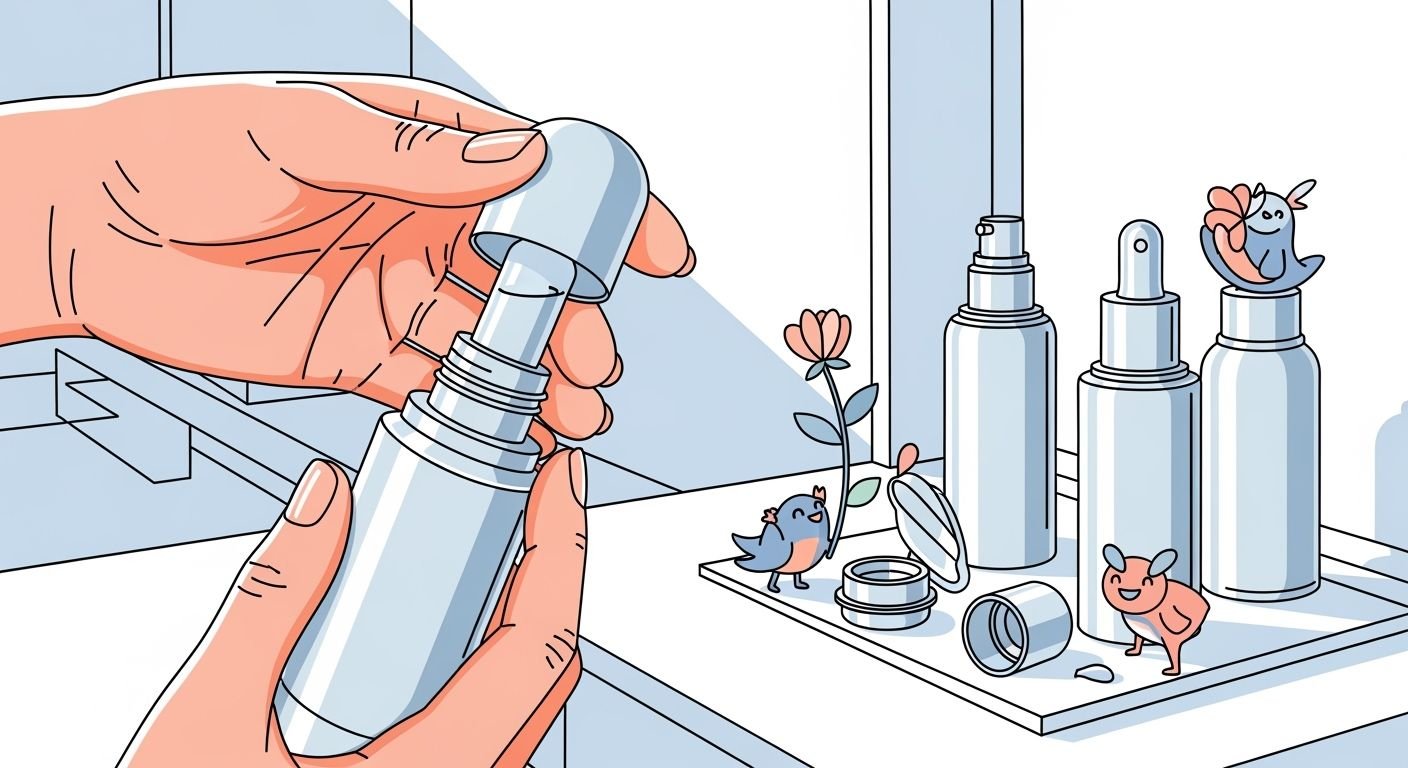
Define what is replaced and what stays
List the retained outer shell, lid, actuator and any reusable connector separately from the replacement cartridge and its supplied closure. Identify which parts contact the formula. Some systems replace the pump with each cartridge; others retain a pump or actuator. These routes require different evidence. Do not assume the visible outer bottle is the product-contact container.
Ask for the supplier’s intended replacement sequence and a complete component list. The existing airless refill guide explains why ordinary airless packs should not be treated as universally refillable. This article focuses specifically on the mating interfaces and repeat replacement of a purpose-designed cartridge.
Inspect the insertion path
Use drawings and actual samples to identify the guide surfaces, keys, threads, snaps and seating stops. Check whether the cartridge can be inserted at the wrong angle, whether orientation is obvious and whether the user can distinguish full seating from partial engagement. A click can provide feedback, but the sound alone does not demonstrate a correct liquid-path connection.
Keep the outer shell and cartridge sample identities connected in the record. Compare representative combinations rather than repeatedly using one exceptionally smooth pair. If samples come from different tooling or revisions, preserve that distinction. A mixed trial can reveal a fit problem but cannot justify approval of a revision that was not actually tested.
Separate shell retention from dispensing connection
A cartridge may be mechanically held in place while the pump connection remains incomplete. Inspect both functions. Check the assembled height, actuator clearance and whether the replacement sequence leaves a connector, seal or transport closure in the wrong position. Run the intended dispensing sequence on the complete filled system after replacement.
Keep initial priming observations distinct from normal output. Do not repeatedly reseat a cartridge until it works and then log only the successful attempt. Record the first insertion, the corrective action and any unsuccessful dispensing. A buyer needs to know whether the system supports the intended user sequence without undocumented intervention.
Evaluate repeated replacement, not just repeated pumping
Define the number and sequence of replacement events with the brand and supplier for the proposed service life. Do not assign a universal reuse count. At each checkpoint inspect the retaining surfaces, guide features, threads, snaps and retained pump components. Record cracks, distortion, loose engagement and changes in insertion or removal effort.
Use the intended cartridge handling route, including removal of the supplied transport protection. If the system involves formula-contact parts retained between refills, the responsible development team must define the hygiene and compatibility requirements. Do not invent a household cleaning procedure or claim that an attractive airless format eliminates preservation testing.
Inspect the outer decoration separately. Cartridge replacement can involve gripping and twisting surfaces that ordinary dispensing seldom touches. Record scratching or transfer around the grip zone, and check whether decoration obscures orientation marks. Functional fit and appearance durability should have separate acceptance decisions.
Give the filler an assembly-ready specification
Identify whether cartridges arrive open, closed or already fitted with dispensing components. Confirm how the filler holds them, applies closures and verifies assembly. The guide surfaces used by a consumer are not necessarily appropriate locating surfaces for a machine fixture. Run production-representative samples through the actual filling and assembly route.
Record any force or height checks used on the line with the agreed method and responsible operator. A nominal cartridge capacity is not enough to define filling clearance or the assembled displacement. Use the model’s specified fill route and the actual formula. Attach the resulting line observations to the complete sample approval record.
Manage replacement stock for wholesalers
Assign different stock codes to the complete starter pack, refill cartridge and retained replacement components. Include capacity, interface revision and formula or customer allocation where relevant. Similar-looking cartridges should not be sold as interchangeable without approval. Use carton labels and order descriptions that identify which outer pack they fit.
Before a reorder, ask whether either side of the mating interface has changed. A new cartridge revision may require a check against retained outer shells already sold to customers, not only against new shells. Agree how obsolete stock will be handled and who communicates a non-interchangeable change. Otherwise a technically improved cartridge can create a supply problem for the installed customer base.
Do not convert refillability into an environmental guarantee
A refill programme needs actual replacement uptake, packaging quantities and the relevant supply route before its environmental benefit can be assessed. This interface trial proves only the stated mechanical and dispensing observations. It does not demonstrate lower emissions, recyclability in every market, nearly complete evacuation or longer finished-product shelf life.
Quotation and approval checklist
- Complete starter-pack and replacement-cartridge references.
- Retained and replaced components, with formula-contact roles.
- Insertion, removal, seating and dispensing test sequence.
- Replacement-cycle scope and inspection checkpoints.
- Filling and assembly handoff, packaging and stock-code rules.
- Change-control decisions for cartridges and retained outer packs.
Oulete’s starting MOQ is 5,000 pieces for plastic airless bottles and plastic lotion bottles, and 10,000 pieces for glass packaging and cosmetic tubes. Confirm the separate scope for the chosen refill components, decoration and special tooling. Send the complete interface brief when you request a refill-system quotation and review available airless formats with the supplier before ordering.